A founder messaged us last spring with a spreadsheet full of numbers and a simple question: should she move her $8,000 monthly ad budget from Meta to Google Shopping, or split it? Her skincare brand was doing $40,000 a month in revenue, mostly from Instagram and Facebook, and her CPMs had crept up for the third quarter in a row.
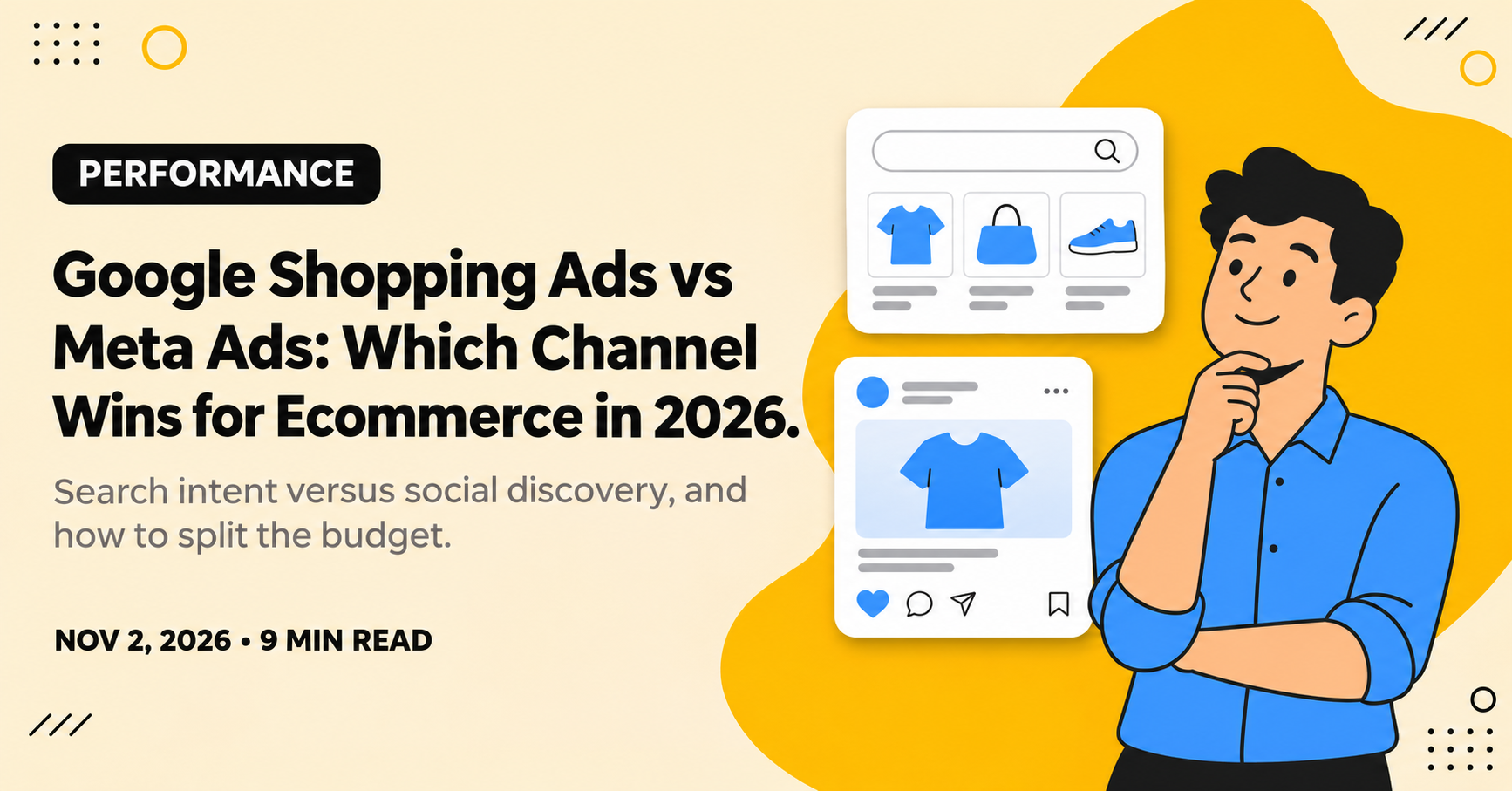
That question, google shopping ads vs Meta ads, comes up constantly in ecommerce circles right now, and the honest answer is neither platform "wins" in isolation. They solve different problems. Google Shopping captures demand that already exists. Meta creates demand where none existed a scroll ago.
Get the distinction wrong and you'll waste months optimizing the wrong lever.
What Each Channel Is Actually Built To Do
Google Shopping ads show up when someone searches "ceramic coffee mug with lid" or "women's running shoes size 8." The person typing that query already wants the product. Your job is to show up, look trustworthy, and price competitively.
Meta ads interrupt a feed. Nobody searched for your mug. You're introducing the idea that they need one, using a scroll-stopping video or a before-and-after photo, and hoping the hook lands before their thumb moves on.
This is the core split between intent-based and interest-based advertising, and it changes everything downstream: creative requirements, budget pacing, and how fast you can expect results.

Search-based intent means Google Shopping campaigns often convert faster per click. You're not educating anyone, you're closing a decision that's already 80% made. Meta campaigns need more creative iterations before they find a winning angle, because you're fighting for attention against cat videos and a friend's engagement announcement.
Neither approach is wrong. They just answer different questions about where your customer is in their buying journey.
Cost Structure: Where The Money Actually Goes
If you want to advertise on Google Shopping, your main costs are feed management, bidding strategy, and product image quality. Google pulls from your product feed (title, price, images, availability) and matches it to search queries automatically. You're not writing ad copy in the traditional sense, you're optimizing data.
Meta spend goes almost entirely into creative production and testing volume. A single Meta campaign might need 15 to 20 creative variations tested over two weeks before one or two break through and scale. That's video editors, UGC creators, and a testing budget that doesn't directly produce revenue.
Here's a rough way founders in our network have broken it down for a mid-size DTC brand doing $100k/month in revenue:
- Google Shopping: 60% of budget to media spend, 25% to feed optimization and merchant center hygiene, 15% to landing page work
- Meta ads: 40% of budget to media spend, 45% to creative production, 15% to testing infrastructure and reporting
That second number, 45% to creative, surprises a lot of first-time Meta advertisers. It's the real cost nobody mentions in the "just run ads" pitch.

There's also a seasonality factor. Google Shopping CPCs spike hard during Black Friday and the December gifting window because every competitor is bidding on the same high-intent terms. Meta CPMs rise too, but the increase tends to be gentler since it's an auction across a much larger inventory of feed placements.
When Google Shopping Wins Outright
Products with clear specifications win on Google Shopping. Think kitchen appliances, phone cases, car parts, or anything someone would type into a search bar with a model number attached.
If your category has high search volume and your margins can absorb competitive CPCs, Google Shopping should be your first dollar rather than your last.
The skincare founder we mentioned earlier eventually ran a split test. She kept 70% of budget on Meta for top-of-funnel awareness, and moved 30% to Google Shopping to catch the branded searches her Meta ads were already generating.
Within six weeks her blended ROAS improved by 22%, mostly because people who'd seen her product three times on Instagram were now searching her brand name on Google, and Shopping ads caught them at that exact moment with a frictionless path to checkout.
That's the pattern we see again and again: Meta builds the awareness, Google Shopping harvests the resulting search demand. Treating them as competitors rather than a sequence is the single most common mistake we see in ecommerce accounts.
When Meta Wins Outright
New categories with no existing search volume need Meta. If you've invented a product nobody's searched for yet, like a specific wellness gadget or a niche subscription box, Google Shopping has nothing to show because nobody's typing that query.
Meta also wins for impulse-priced items under roughly $50, where the purchase decision happens in seconds based on an emotional hook rather than comparison shopping. A $28 silicone phone grip sells through a well-made 15-second video far more often than through a search ad, because nobody researches a $28 impulse buy.
Visual, story-driven products (apparel, home decor, beauty) also lean Meta, since the format rewards strong imagery and video over text-based product listings.
The Conversion Rate Optimisation Layer Both Channels Need
Here's where a lot of ecommerce teams leave money on the table: they pour budget into acquisition and never touch conversion rate optimisation on the landing page itself.
A Google Shopping click that lands on a cluttered product page with no trust signals converts at half the rate of one that lands on a clean page with reviews, clear shipping info, and a fast load time. Same traffic, wildly different outcome, purely because of what happens after the click.
A few CRO basics that move the needle regardless of which ad channel sent the traffic:
- Page speed under 2.5 seconds on mobile, since both Google and Meta traffic skew heavily mobile
- Social proof above the fold, star ratings or review counts visible without scrolling
- One clear call to action per page, not three competing buttons
- Shipping and return policy visible near the price, not buried in a footer link
We've written more on fixing underperforming landing pages without a full rebuild in our piece on website redesign versus targeted optimization, which applies whether your traffic comes from Shopping or Meta.

Where Amazon Fits Into This Conversation
Most ecommerce founders running this debate are also selling on Amazon, and it changes the math. Amazon advertising competes for the same search intent as Google Shopping, except the buyer is already on a platform built for one-click purchasing with saved payment info and Prime shipping.
If a meaningful share of your revenue already comes through Amazon, some of your Google Shopping budget may be better spent defending your own site's margin instead of competing against your own Amazon listing for the identical search term. This isn't a reason to ignore Google Shopping, it's a reason to map out which channel owns which part of the customer journey before splitting budget three ways.
A Simple Framework For Deciding Your Split
Ask these three questions before setting next quarter's budget:
- Does my product have existing search volume? If yes, Google Shopping deserves real budget.
- Is my average order value under $50 and visually driven? If yes, weight toward Meta.
- Am I already getting branded search traffic from past Meta exposure that I'm not capturing? If yes, add Google Shopping to catch it.
Most brands land somewhere between 50/50 and 70/30 once they've run both channels for a full quarter and looked at assisted conversions rather than last-click numbers alone. Last-click attribution almost always undervalues whichever channel runs earlier in the funnel, usually Meta.
Takeaways
- Google Shopping captures existing demand, Meta creates new demand, and most brands need both working together rather than picking one.
- Budget allocation differs sharply: Shopping spend goes mostly to media and feed quality, Meta spend goes heavily into creative production.
- Products with clear specs and search volume favor Google Shopping, impulse-priced and visually driven products favor Meta.
- Conversion rate optimisation on the landing page can double the value of traffic from either channel without spending another rupee or dollar on ads.
- If Amazon advertising already drives meaningful revenue, factor that into your Google Shopping bids so you're not bidding against your own listing.
- Review spend quarterly using assisted conversions, not just last-click data, since Meta's real contribution usually shows up later in the funnel.
If you're trying to figure out the right split for your specific catalog and margins, it helps to have a second pair of eyes on the actual account data rather than guessing from benchmarks. You can see how we've approached this for other ecommerce clients in our comparison of agency approaches, or look at the numbers behind performance accounts we've run in our case studies. For a direct conversation about your specific budget split, a 30-minute call usually surfaces more than another week of testing blind.
This topic connects closely to two other decisions ecommerce founders face around the same time: whether to run Amazon advertising alongside Google Shopping, and whether their current setup needs an in-house CRO effort or a dedicated CRO agency to actually convert the traffic these ad channels generate. For broader context on paid acquisition decisions beyond ecommerce, our piece on choosing between a PPC specialist and a Google Ads generalist covers similar tradeoffs. And if performance marketing support is something you're evaluating generally, our performance marketing services page outlines how we approach these accounts.