A homeware brand we worked with last year got an email from Amazon's vendor recruitment team out of nowhere. Amazon wanted to buy their stock wholesale and sell it under the Amazon badge, no more listing management, no more customer messages.
The founder nearly said yes on the spot. Then she asked us to run the numbers first, and the numbers changed her mind.
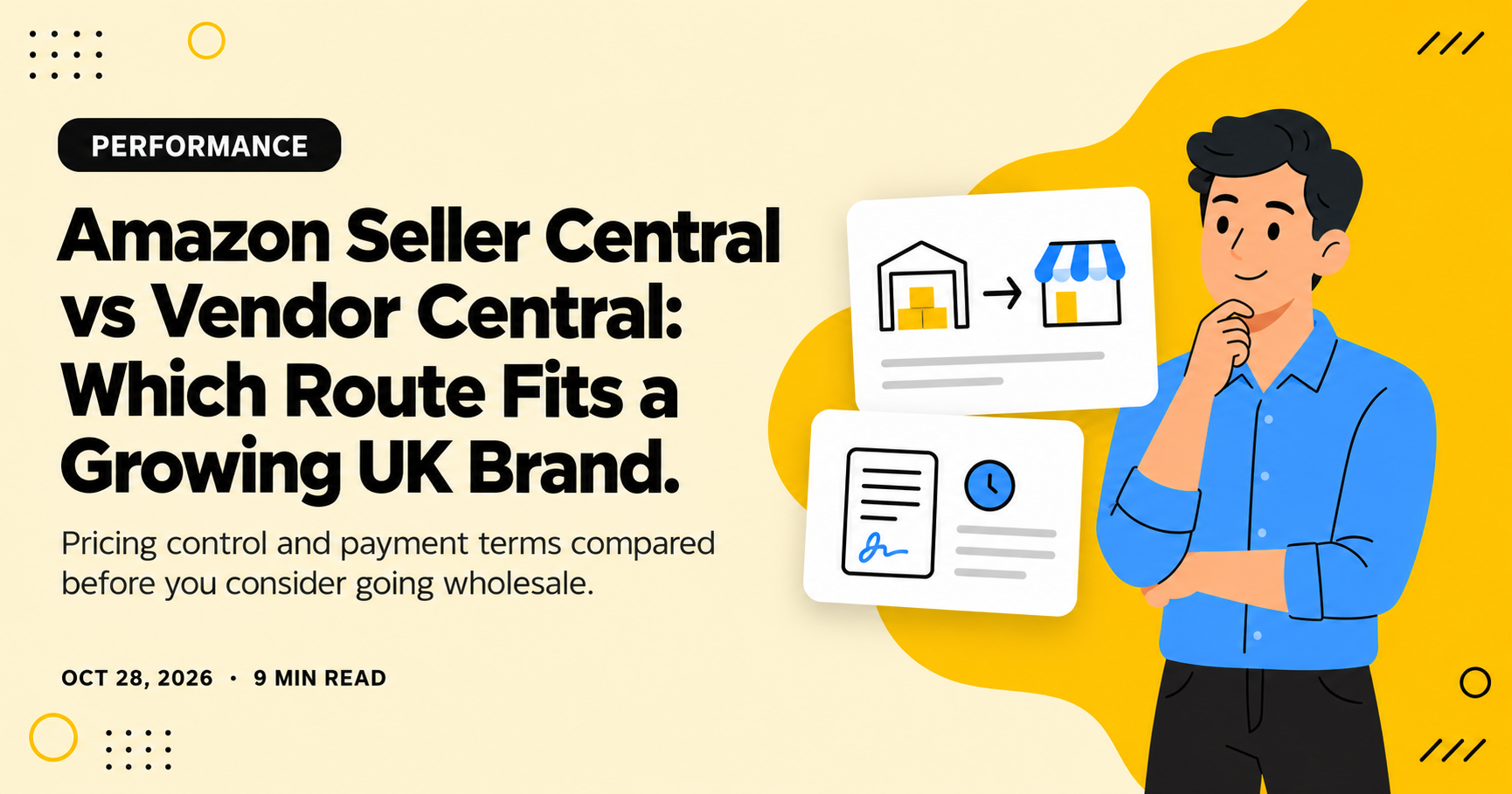
That's the amazon seller central vs vendor central uk decision in miniature. One route keeps you selling direct to shoppers. The other hands your stock to Amazon and lets them sell it as a retailer would. Both are real businesses people run profitably. The question is which one fits where your brand actually is.
We'll walk through pricing control, payment terms, advertising access and the revenue stage where switching starts to make sense.
What Each Model Actually Is
Amazon Seller Central is third-party selling. You list your own products, set your own prices, and manage your own stock levels. Amazon takes a referral fee, typically 8 to 15% depending on category, plus fulfilment costs if you use FBA.
You are the merchant of record. The customer buys from "your brand, sold by [you]" or "sold by Amazon" if you're enrolled in FBA, but you still own the listing.
Amazon Vendor Central is first-party selling. You become a wholesale supplier. Amazon's buying team places purchase orders for stock at a price you negotiate, Amazon owns the listing content, sets the retail price, and sells it as "Ships from and sold by Amazon.com" or Amazon.co.uk.
The core difference is who's the retailer. On Seller Central, you are. On Vendor Central, Amazon is, and you become its supplier the same way a food brand supplies Tesco.

Most UK brands start on Seller Central because it's self-serve. You sign up, list products, and you're trading within days. Vendor Central is invite-only in almost every case. Amazon's retail team reaches out when a brand already has volume and sales history worth buying in bulk.
A handful of categories (certain FMCG and grocery lines) sometimes get a Vendor Central nudge earlier, but for most consumer brands the invite comes after Seller Central has already proven the product sells.
Pricing Control: This Is The One That Surprises People
On Seller Central, you set the price. You can run a flash sale, raise prices during a stock shortage, or hold a premium position because you know your margins better than anyone. Change it in the dashboard and it's live in minutes.
On Vendor Central, Amazon sets the retail price. You negotiate a wholesale cost, Amazon adds its own margin, and the shelf price is whatever Amazon decides will move units. This is the single biggest trade-off brands underestimate before switching.
We've seen Vendor Central sellers watch Amazon discount their product by 30% during a sale event with zero notice, eating straight into margin they didn't plan for. You can push back through your vendor manager, but you don't hold the lever.
There's a knock-on effect too. If Amazon prices below your RRP on other channels, you can end up undercutting your own Shopify store or wholesale retail partners without meaning to. A kitchen brand we advised had this exact problem: their own website was £34.99, Amazon dropped to £27 during Prime Day, and their retail partner in a department store called asking why.
Payment Terms: Cash Flow Changes Completely
Seller Central pays out roughly every 14 days, direct to your bank account, based on what actually sold. It's fast and it matches real demand. If you sell £10,000 this fortnight, you get roughly that minus fees, two weeks later.
Vendor Central runs on purchase orders and invoices, like supplying any big retailer. Standard terms run 30, 60, or sometimes 90 days from invoice. You get paid for what Amazon ordered, not what customers bought.
If Amazon over-orders and the stock sits in their warehouse unsold, you've still been paid for it. Good news, until the next PO shrinks to compensate, often with little warning.
The practical effect: Vendor Central needs working capital to bridge that 30 to 90 day gap. A brand doing £40,000 a month in wholesale revenue on 60-day terms needs roughly £80,000 just sitting in the gap between shipping stock and getting paid for it. Seller Central doesn't ask that of you.

This is usually the deciding factor for brands under roughly £1 million in annual revenue. The margin trade-off on Vendor Central only pencils out once volume is high enough that the cash-flow gap doesn't strangle the business while it waits to get paid.
Some brands run both. They stay on Seller Central for their own-brand ASIN control and move specific high-volume SKUs to Vendor Central once a category buyer approaches them, keeping the rest direct. It's more admin, but it protects the parts of the catalogue where pricing control matters most.
Advertising Access: Not As Different As People Assume
Both models give you access to amazon advertising, but the toolset shifts. Seller Central gets you Sponsored Products, Sponsored Brands and Sponsored Display, the full self-serve suite most UK sellers already run.
Vendor Central gives you a few extras. Amazon DSP access tends to come easier. Sponsored Brands video gets priority placement.
Amazon's A+ Content, now called Brand Story in some categories, can be richer too. None of this is exclusive forever, though. Amazon has steadily opened more advertising formats to registered sellers on Seller Central, provided you're Brand Registered.
Brand Registry matters more than which Central you're on. Register your trademark, and A+ Content, Brand Analytics, and Sponsored Brands all open up on Seller Central, no Vendor Central required. That closes most of the advertising gap people assume only exists on the vendor side.
Where Vendor Central genuinely pulls ahead is Amazon's own marketing push: inclusion in Amazon-curated deals pages, better odds at Subscribe & Save slots, and sometimes placement in physical retail tie-ins Amazon runs with FMCG partners. If that kind of exposure matters to your category, it's a real reason to consider the switch, not just a side benefit.
Which Stage Of Brand Actually Needs Vendor Central
Here's the honest version, not the sales pitch Amazon's recruitment team gives.
Stay on Seller Central if any of these are true: you're under £1 million in annual UK Amazon revenue, your margins are thin enough that a 30% surprise discount would hurt, you need payment within weeks rather than months, or you want to protect your retail price across every channel you sell on.
Consider Vendor Central if Amazon's own recruitment team has actually approached you. Don't chase this yourself; it rarely works the other way round.
It also fits when you have strong enough cash reserves to cover 60-to-90-day payment gaps, and you're happy to trade day-to-day pricing control for Amazon's retail muscle behind your listings. One more sign: your product sits in a category like FMCG, grocery, or consumer electronics accessories, where Amazon's own merchandising weight genuinely moves more volume than your own listing work would.
The homeware founder we mentioned at the start turned the Vendor Central invite down. Her margins were sitting at 22%, tight enough that a mid-sale discount would have wiped out a full month of profit. She didn't have the cash buffer for 60-day terms either.
She stayed on Seller Central instead. She registered her trademark, built out A+ Content, and grew UK revenue 40% the following year through paid search she ran herself rather than handing the keys over.
That's usually the right call under £1 million. Above £3 to 5 million with healthy reserves, the calculus flips, and Vendor Central's retail muscle starts to outweigh the control you give up.
The Takeaway
Seller Central means you set the price. Vendor Central means Amazon does, often without warning.
Payment lands in roughly 14 days on Seller Central, 30 to 90 days on Vendor Central, so check your cash buffer before saying yes to an invite.
Register your trademark through Brand Registry before weighing Vendor Central. It closes most of the advertising gap on its own.
Vendor Central tends to make sense above £1 to 3 million in annual Amazon revenue with cash reserves to match, not before.
You can run both models on different SKUs if a category buyer only wants part of your catalogue.
If you're already weighing PPC agencies against running ads in-house for the rest of your paid channels, the same control-versus-convenience trade-off applies here too.
If you're deciding which route fits your brand and want a second set of eyes on the actual numbers rather than Amazon's pitch, see how we think about agency vs in-house. Or book a free 30-minute call and we'll go through your margins together.